
Aramid fiber
芳纶纤维 / Aramidfaser / 아라미드 섬유
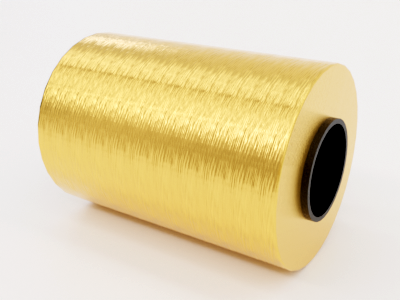
A polyamide fiber with the highest tensile strength among synthetic organic fibers—lightweight, highly impact-absorbing, and possessing excellent heat resistance, flame retardancy, and chemical resistance also.
There are two types: meta-type, which offers high heat resistance, and para-type, which is lightweight and features high strength.
protective gear, automotive tire reinforcements, aircraft components, seismic reinforcement materials, and cable reinforcements etc.
Manufacturing process
※This process is just one example, and the manufacturing methods vary by company.

If there are dead zones (areas that are not sufficiently stirred) inside the reactor, or if the gaps at the connection points with downstream equipment are not properly managed, the raw materials may deteriorate or solidify, potentially causing operational issues with the equipment.

The twin-screw continuous kneader, "KRC Kneader" has the following mechanical characteristics, which result in minimal dead zones and allow for proper design and management of the gaps between screws at the connection points with downstream equipment.
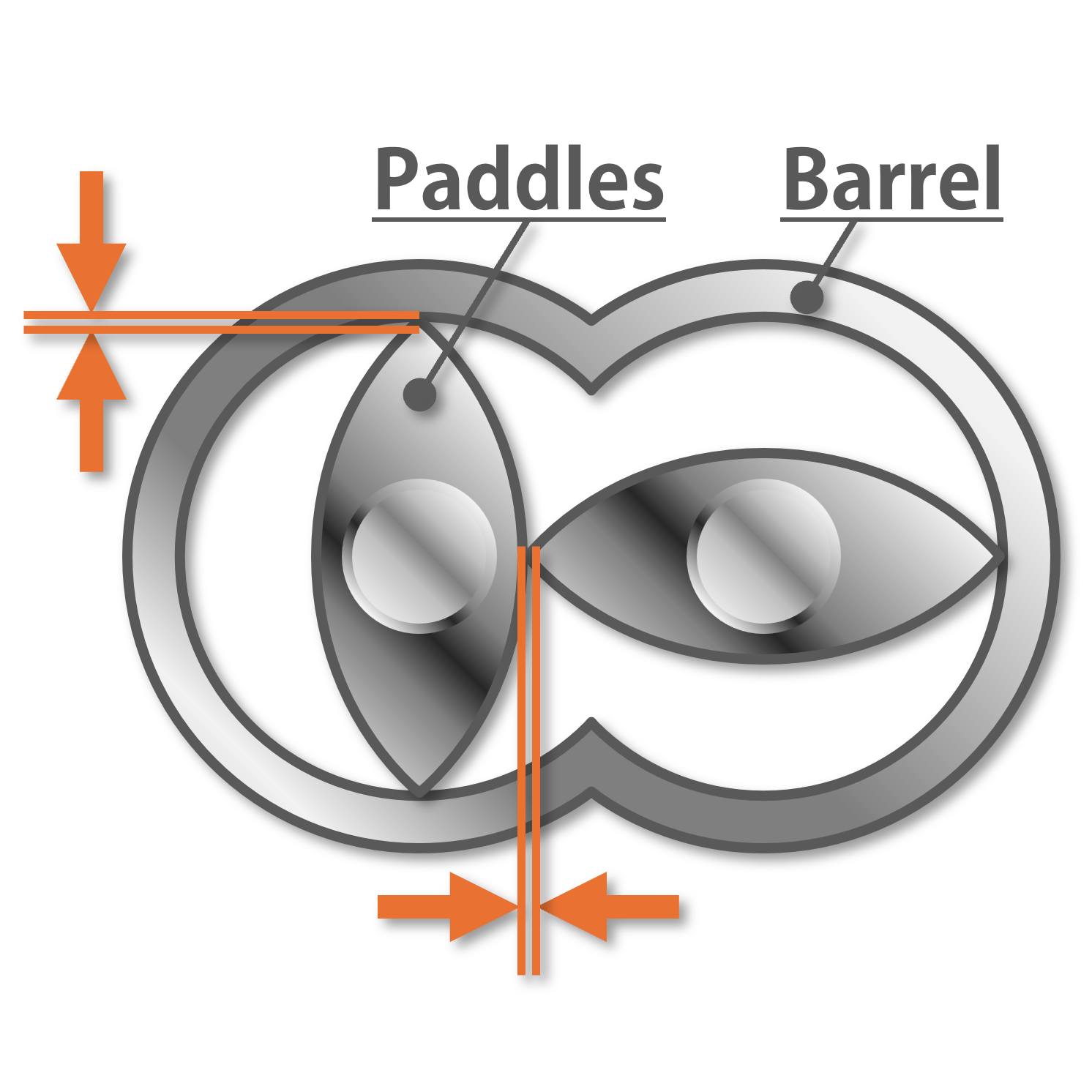
Excellent dispersion effect achieved by paddles with small clearances
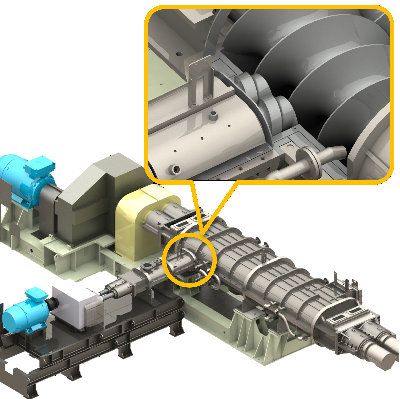
Ingeniously engineered connection to the downstream polymerization reactor
reaction
It is required to smoothly handle pre-mixed materials whose viscosity changes due to phase transitions (from slurry to high-viscosity material to flakes). In addition, sufficient residence time must be ensured to complete the reaction.
The twin-shaft continuous kneader "KRC Kneader" enables stable processing of materials undergoing phase transition, thanks to the following mechanical features. In addition, even for large throughput, selecting an appropriately sized machine ensures sufficient residence time, allowing the reaction to be fully completed.
Adhesion is minimized by the self-wiping function of the paddles.
Kneading is performed with a uniform residence time distribution (plug flow).
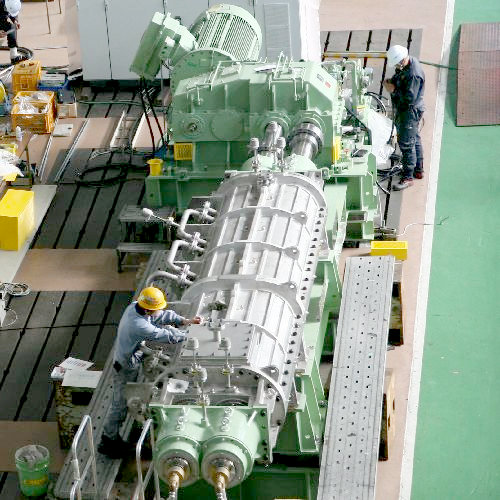
Extensive experience in the production of a broad range of sizes, from small to large-scale models.
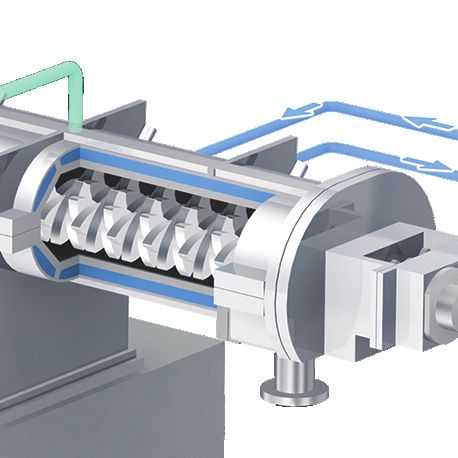
Removal of kneading heat by cooling through the jacketed barrel
process
If the pre-mixing is insufficient, variations may occur in the quality of the subsequent dissolution step. Since relatively large-scale equipment is used in next step, the costs associated with maintenance and consumable replacement for quality improvement will be higher.
The twin-shaft continuous kneader "KRC Kneader" allows adjustment of processing load and kneading intensity through the following mechanical features. By increasing the kneading load in the pre-mixing step using a small-scale machine, the maintenance frequency of the subsequent large dissolving equipment can be reduced, contributing to lower overall operating costs for the process.

The mixing intensity can be controlled by modifying the paddle arrangement or adjusting the rotational speed.
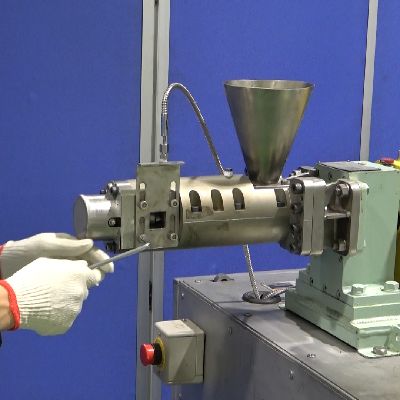
Extensive experience in the production of a broad range of sizes, from small to large-scale models.
Insufficient agitation due to dead zones, or inadequate residence time, can lead to the presence of aggregated granules and undissolved material, thereby deteriorating the processability of the granules.
The twin-shaft continuous kneader, "KRC Kneader," features mechanical characteristics that minimize dead zones. Additionally, by using large-scale units, sufficient residence time can be ensured, allowing for complete dissolution of the granules.
Excellent dispersion effect achieved by paddles with small clearances
Extensive experience in the production of a broad range of sizes, from small to large-scale models.
Removal of dissolving heat by cooling through the jacketed barrel
process